PRISON PUZZLE COMPETITION
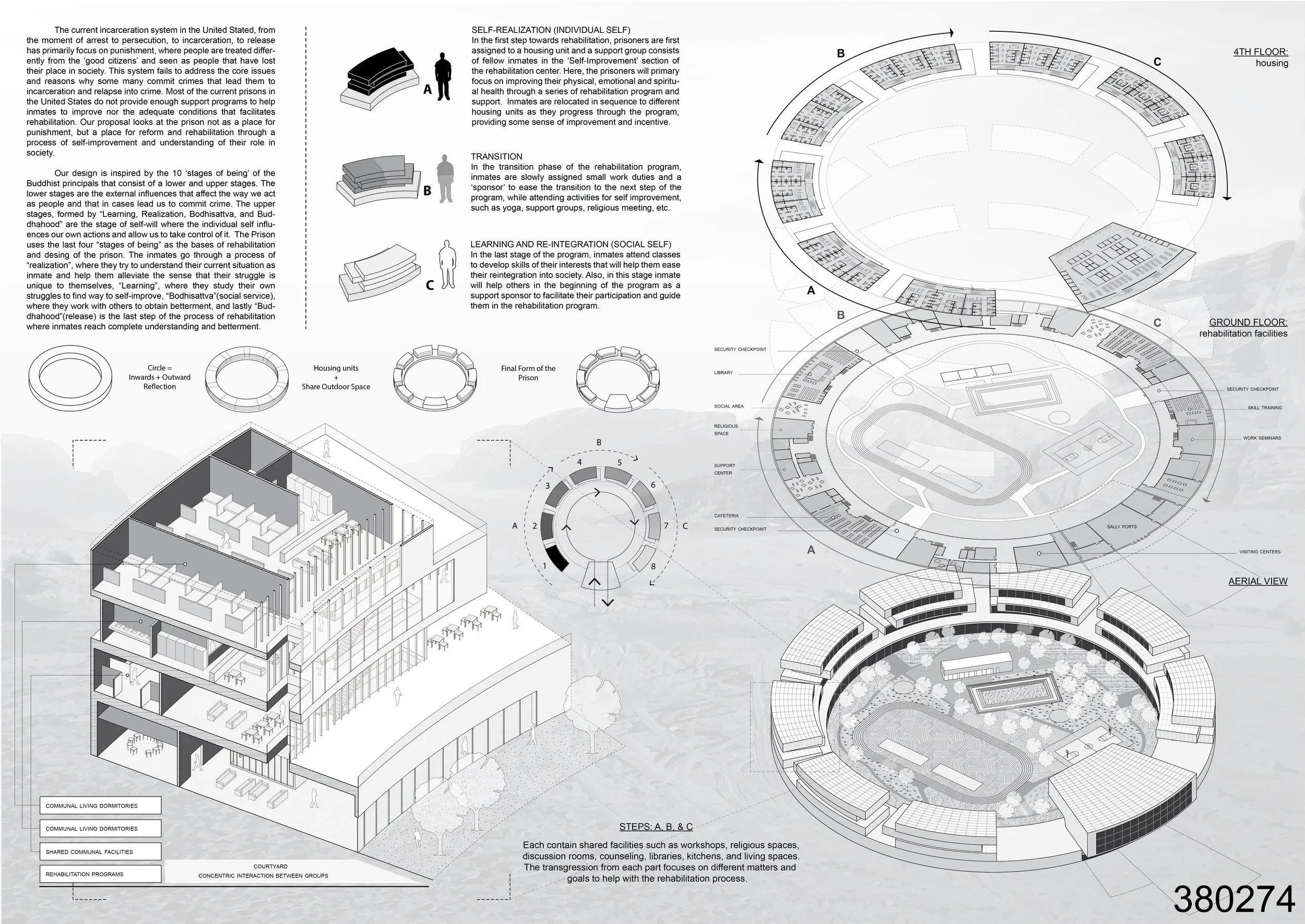
The current incarceration system in the United Stated, from the moment of arrest to prosecution, to incarceration, to release has primarily focus on punishment, where people are treated differently from the ‘good citizens’ and seen as people that have lost their place in society. This system fails to address the core issues and reasons why some many commit crimes that lead them to incarceration and relapse into crime. Most of the current prisons in the United States do not provide enough support programs to help inmates to improve nor the adequate conditions that facilitates rehabilitation. Our proposal looks at the prison not as a place for punishment, but a place for reform and rehabilitation through a process of self-improvement and understanding of their role in society.
Our design is inspired by the 10 ‘stages of being’ of the Buddhist principles that consist of a lower and upper stages. The lower stages are the external influences that affect the way we act as people and that in cases lead us to commit crime. The upper stages, formed by “Learning, Realization, Bodhisattva, and Buddhahood” are the stage of self-will where the individual self influences our own actions and allow us to take control of it. The Prison uses the last four “stages of being” as the bases of rehabilitation and design of the prison. The inmates go through a process of “realization”, where they try to understand their current situation as inmate and help them alleviate the sense that their struggle is unique to themselves, “Learning”, where they study their own struggles to find way to self-improve, “Bodhisattva”(social service), where they work with others to obtain betterment, and lastly “Buddhahood”(release) is the last step of the process of rehabilitation where inmates reach complete understanding and betterment.
Designed by Vicente Shum & Kenny Chao